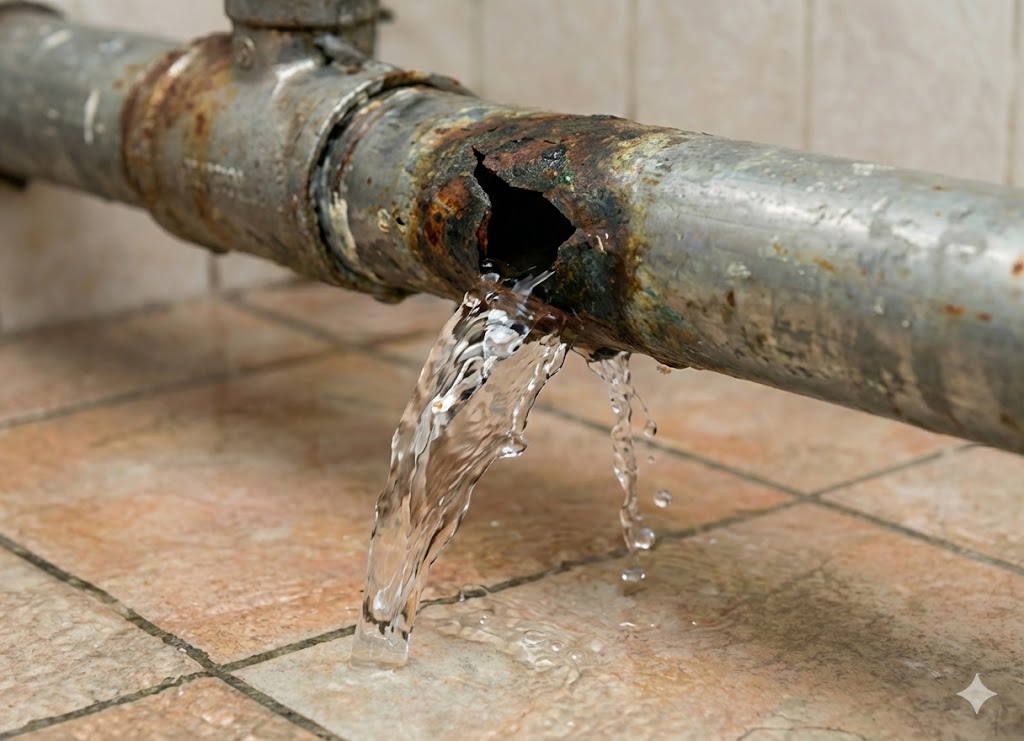
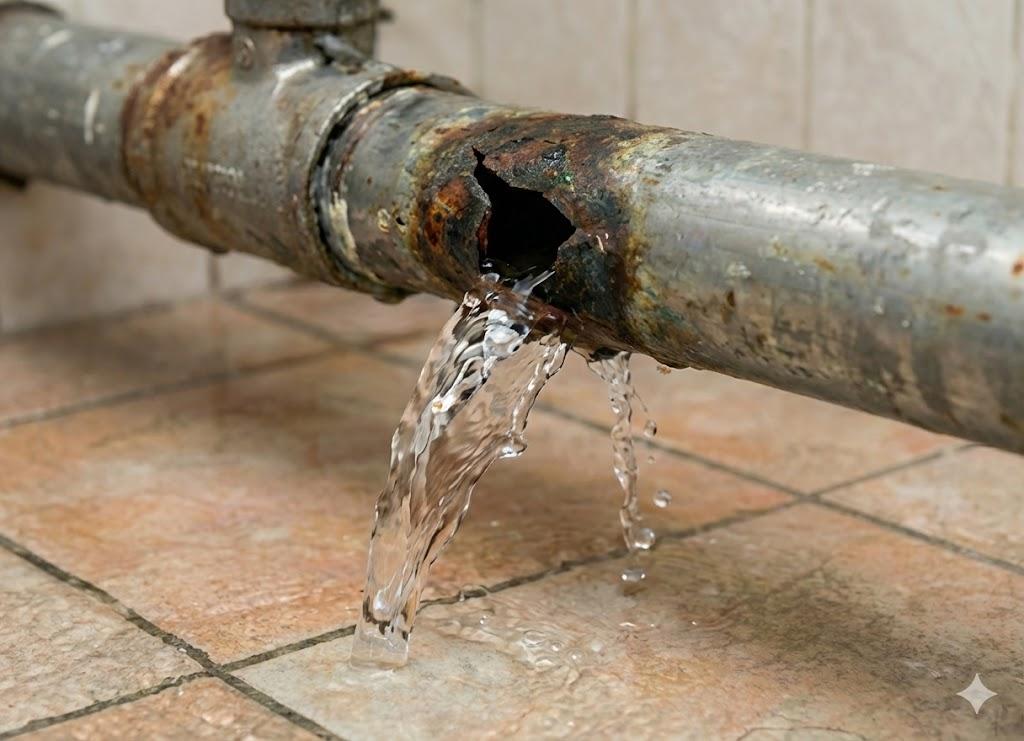
Short answer: when a downstairs neighbor reports dripping or wall efflorescence and peeling (壁癌) on the balcony ceiling, it does not necessarily mean your watering caused it. In engineering terms, balcony leaks fall into three types: a burst concealed water supply pipe (leaks continuously, 24 hours a day), a leaking drain pipe joint (leaks only when water is used or when it rains), and an aged floor waterproofing layer combined with water pooling under flower pots and seeping through. There are 3 on-site self-check steps. Step 1: turn off all taps at home and stop using water (including the washing machine) for 2 hours, then watch whether the water meter needle or the small red flower is still turning; if it is, there is a leak in the piping and wiring behind the water meter, meaning the pipes. Step 2: stop watering the balcony and stop using the washing machine for 3 to 5 days, and see whether the water stain downstairs dries out and shrinks. Step 3: check whether pots sit directly on the floor, leaving the tile joints constantly wet and black with mold.
Do Balcony Plants Cause Leaks Below? Liability in Taiwan
This article is compiled from publicly available online sources for general reference only; readers should independently verify and judge its accuracy, and it is not legal, tax, medical or engineering advice. Rules, fees and subsidies change; check the latest notice from the responsible authority before acting. For electrical, gas, structural or health risks, consult a qualified professional.
This is the English edition of a Chinese article, adapted with AI assistance and checked against the original. Where the two differ, the Chinese version and the official sources it cites prevail.
Why Does Pot Watering Leak Downstairs? Aged Balcony Waterproofing and Capillary Seepage
In the Taipei and New Taipei area of Taiwan, many older apartments and mid-rise buildings with a building age of over 20 to 30 years were built under loose waterproofing standards for front and rear balconies. Builders often just laid tiles known as 丁掛磚 or 二丁掛磁磚 after the slab was poured, with no elastic cement or polymer waterproof coating under the floor at all; even where waterproofing was applied early on, decades of thermal expansion and contraction and earthquake shaking have long since aged it, cracked it and stripped away its elasticity.
When owners keep many plants on the balcony and the pots sit flat on the tiles, the water that runs out is covered by the pot base for long periods and cannot evaporate, so the tile grout (white cement) stays damp, hydrolyzes and turns to powder. Through capillary action, water travels along the grout pores into the cement mortar bed (commonly called 騷底) and forms a long-term water-holding layer on the surface of the structural slab. Cement is rich in calcium hydroxide; when moisture combines with carbon dioxide it precipitates as white crystalline wall efflorescence (白華). Once too much water accumulates, it seeps through tiny cracks in the structural slab to the ceiling below, causing the downstairs neighbor's paint to blister, the putty to mold and peel, and even continuous dripping. If a clogged drain pipe is also involved, first use the Leak Liability Checker to clarify who is responsible, and use the Leak Water-Bill Loss Calculator to estimate the water volume.
Don't Pay or Break Walls Yet: 3 Steps to Find the Real Culprit (Supply Pipe vs Drain Pipe vs Waterproofing)
When a downstairs neighbor comes to report a balcony leak, never immediately and blindly admit liability for compensation or agree to break open your own floor. Blind demolition often opens up the tiles only to find that the leak source has nothing to do with watering. Stay rational and work with your neighbor to carry out the following 3 checks:
- Water meter pressure-hold and shut-off test (checks the concealed supply pipe): Before leaving for work or going to bed, tightly close all taps and toilet supply angle valves in the home; using any tap water is strictly prohibited. Go to the water meter box on the roof or in the stairwell and record, on phone video, the needle position and the central small red flower (the low-flow indicator needle). If, with nobody using water, the small red flower keeps turning slightly, the concealed supply pipe buried in the wall or floor is cracking and seeping. This is a pressurized pipe burst leaking 24 hours a day and has nothing to do with watering plants. You can use the Leak Water-Bill Loss Calculator to estimate the leaked volume.
- Pause-watering wet/dry comparison (checks the floor waterproofing layer): If the water meter is completely still, temporarily move all balcony pots into large plastic storage boxes, and stop watering the balcony, washing the floor and running the washing machine for 72 hours up to 5 days continuously. Also ask the downstairs neighbor to photograph the ceiling stain area at a fixed time every day. If the dripping from the downstairs ceiling stops completely 2 days after watering stops and the stain visibly turns pale and dries, aged balcony floor waterproofing leaking through is highly suspected.
- Drain plug flood test and colored-water test (checks the drain pipe joint): If it is still damp downstairs after you stop watering, block the balcony floor drain with a dedicated inflatable bladder, then use a hose to pour water tinted with food coloring (such as Food Red No. 6 or blue-colored water) into the pipe for a ponding test. Watch whether colored liquid comes out at the leak point downstairs, to determine precisely whether the drain stack joint passing through the slab is broken.
Three Balcony Leak Types: Detection Signs and Legal Responsibility Comparison
Damage to different pipes and structures shows very different seepage behavior, and legal responsibility is also clearly divided. The table below compares the 3 common balcony leak types in Taiwanese multi-unit housing:
| Leak cause category | Seepage signs on the downstairs ceiling | Result of your own water meter shut-off test | Change after 3 days without watering | Commonly applicable statutory repair responsibility (under Articles 10 and 12 of the Condominium Administration Act) |
|---|---|---|---|---|
| Burst concealed supply pipe inside the slab | Steady dripping 24 hours a day, clear water | Water meter small red flower or needle turns slightly | No improvement, keeps dripping | Shared by the upstairs and downstairs owners (Article 12), or, depending on which unit the piping exclusively serves, borne by that unit's owner |
| Failed balcony floor waterproofing plus pooled water from watering | Seeps only some hours after heavy watering, floor washing or a rainstorm | Water meter completely still | Stain visibly dries, dripping slows | Borne solely by the upstairs household (Article 10, maintenance of exclusively owned parts, or Article 12, attributable cause) |
| Common rainwater downpipe / exterior wall crack seepage | Seeps only in typhoons or heavy rain; no leak at all when watering on sunny days | Water meter completely still | Unrelated to watering; depends on rainfall | Borne by the management committee's common fund (Article 10, repair of common areas) |
What Does the Condominium Administration Act Say? Exclusively Owned Parts, Shared Floor Slabs and Repair Cost Sharing
In Taiwan's legal practice, leak disputes inside condominiums are mainly handled under the Condominium Administration Act and the Civil Code (this section summarizes the current provisions as a reference for repair discussions; it is not formal legal advice, and individual disputes are subject to professional appraisal bodies and court judgments; source verification date: November 2026 (2026-11)):
Under Article 10, paragraph 1 of the Condominium Administration Act: “The repair, management and maintenance of exclusively owned parts and agreed exclusive-use parts shall be carried out by the respective unit owners or the users of the agreed exclusive-use parts, who shall bear the costs.” This means the tiles on your own balcony floor, its surface waterproofing and any pots you place fall within exclusive or agreed exclusive-use maintenance. If a resident's heavy pooling from watering, or a brick planter the resident built, damages the waterproofing, that is a cause attributable to that resident, who by law must bear the full cost of repair and compensation for the neighbor's damage.
However, for piping buried in the floor slab structure between upper and lower floors, or common rainwater main pipes, Article 12 of the Condominium Administration Act applies: “For the common walls and floor slabs of exclusively owned parts, or the piping within them, the repair costs shall be shared jointly by the unit owners on both sides of the common wall or above and below the floor slab. However, if the repair cost results from a cause attributable to a unit owner, that unit owner shall bear it.” Therefore, if professional testing finds that an aged structure's concealed pipe burst through natural deterioration, the repair cost is shared by the households concerned under Article 12 of the Condominium Administration Act (the share ratio can be negotiated between the parties); if the seepage comes from the building's exterior wall or a common main pipe, the management committee (管委會) should use the common fund for repairs (Article 10, paragraph 2). For rental homes, the responsibilities of tenant and landlord are covered in the Tenant Leak and Power Outage Rights Guide.
Standard Communication Steps With Your Downstairs Neighbor and Low-Demolition Repair Options
In handling neighbor leak disputes, emotional management matters as much as written records. Follow the standard 4-step communication process. Step 1: with empathy, visit the downstairs neighbor's home in person, and photograph and video the ceiling stain area, the dripping frequency and the current damage to the finishes. Step 2: proactively show the neighbor your water meter test records and the before-and-after comparison from stopping watering, to build a shared, rational, evidence-based approach. Step 3: jointly find a third-party professional plumbing and electrical worker acceptable to both sides to inspect the leak source on site. Step 4: after the other side issues a formal repair quotation, sign a settlement agreement that clearly specifies the repair method, the cost-sharing ratio and the warranty period for responsibility. Referring to the transparent plumbing and electrical repair price list makes budget planning better grounded.
If testing confirms a minor seep from a concealed supply pipe, the traditional method usually requires removing all the balcony tiles and the waterproofing layer down to the slab and redoing them, which takes longer and also costs relatively more. In that case, a professional may suggest a low-demolition option: abandon the concealed pipe and run exposed pipe instead, using high-quality stainless steel press-fit pipe or surface-mounted insulated pipe, run directly from the main valve to the balcony tap and water heater. The work usually takes less time, and it not only avoids removing the floor tiles and disturbing the plant landscaping, but the overall cost is also usually lower; the actual plan and price remain subject to on-site assessment and a written quotation. If you have an urgent repair need, you can contact the Taipei and New Taipei 24-hour professional plumbing and electrical team for on-site support at any time.
FAQ
My downstairs neighbor says my plants damaged their ceiling paint and demands I throw all the plants away. Is that lawful?
No. A neighbor has no right to unilaterally demand that you discard plants lawfully kept on your exclusive balcony. Under the Condominium Administration Act and the Civil Code's principle of protecting ownership, keeping potted plants on an exclusive balcony is a legitimate use right; but if watering does cause a leak that infringes on others, the neighbor may by law demand that the infringement be prevented and claim damages (Civil Code Articles 767, 777 and 184). Your legal obligation is therefore to repair the source of the leak and make sure nothing seeps downstairs again; by improving how you water, adding water trays and raised stands, or repairing the floor waterproofing, you can lawfully keep growing plants.
Does leak detection on a balcony always mean breaking up all the floor tiles and redoing the waterproofing?
Not necessarily. It depends on the cause of the leak and the floor structure. If testing confirms a burst concealed hot or cold water pipe, the smartest fix is to switch directly to stainless steel exposed pipe, with no need to remove any tiles; if a minor seep comes from capillary action through the tile joints, provided the structure has no large cracks, first clean the floor thoroughly and let it dry, then apply a highly penetrating crystalline waterproofing agent to strengthen the tile joints, and raise all pots off the floor; only when the waterproofing layer has completely hydrolyzed into powder and the slab drips over a large area is it necessary to strip all the tiles and redo 3 coats of elastic cement and the tile-bonding waterproofing work.
If plants on a rented balcony cause a leak downstairs, is the landlord or the tenant responsible?
Under Civil Code Article 429, repair of the leased property is in principle borne by the lessor (landlord); but under Civil Code Article 432, the lessee (tenant) must keep the leased property with the care of a good manager. If the balcony leak comes from natural aging of the building (such as decades-old rusted piping and wiring, or structural cracks), the landlord bears the repair responsibility; if the tenant, without telling the landlord, builds a brick water-holding planter or a large flower pond on the balcony, or pot soil and sand clog the balcony drain outlet so that the balcony floods over the threshold and leaks downstairs, it is a cause attributable to the tenant, and the downstairs neighbor's damage and the home's repair costs are borne in full by the tenant.
Sources
- National Laws and Regulations Database: Condominium Administration Act Article 10 (verified 2026-11): responsibility and cost bearing for the repair, management and maintenance of exclusively owned parts and common areas.
- National Laws and Regulations Database: Condominium Administration Act Article 12 (verified 2026-11): sharing of repair costs for common walls, floor slabs of exclusively owned parts, or the piping within them.
- National Laws and Regulations Database: Civil Code Article 767 (verified 2026-11): claims to remove and prevent interference with ownership.
- National Laws and Regulations Database: Civil Code Article 777 (verified 2026-11): restrictions on rainwater or other liquids flowing directly onto adjacent real estate.
- National Laws and Regulations Database: Civil Code Article 184 (verified 2026-11): liability for damages in tort.
- National Laws and Regulations Database: Civil Code Article 429 (verified 2026-11): repair of leased property is in principle borne by the lessor.
- National Laws and Regulations Database: Civil Code Article 432 (verified 2026-11): the lessee must keep the leased property with the care of a good manager.
Related reading: Balcony Drain Clogged by Plant Soil: Cleanout, Prevention