The Dark Red Water Illusion in Older Apartments
Short-form video ads frequently showcase plumbing technicians connecting pulse-cleaning machines to residential taps, flushing out dark, tea-colored liquid while claiming it purges heavy metals and restores water flow. Tempted by promises of clean drinking water, many owners of 25- to 40-year-old Taipei walk-up apartments spend NT$3,000 to NT$6,000 on high-frequency pipe cleaning. Tragically, within days of service, water pressure often drops further, or concealed wall pipes burst, causing devastating ceiling leaks in lower apartments.
Engineering Principles of High-Frequency Water Pipe Cleaning
Commercial pipe-cleaning equipment utilizes pneumatic water pulse technology rather than high-frequency electromagnetic radiation:
- Mechanical Pulse Mechanism: A microcomputer valve alternates compressed air and water flow into the domestic supply line, generating controlled water hammer shockwaves, turbulent backwashing, and microscopic cavitation bubbles designed to strip biofilm from inner pipe walls.
- Citric Acid Pre-Soak: Technicians inject a food-grade citric acid solution into the pipe system, letting it sit for 20 to 30 minutes to dissolve mineral calcium scale and loosen surface residues.
What That Rust-Colored Water Really Is: The Tubercle Truth
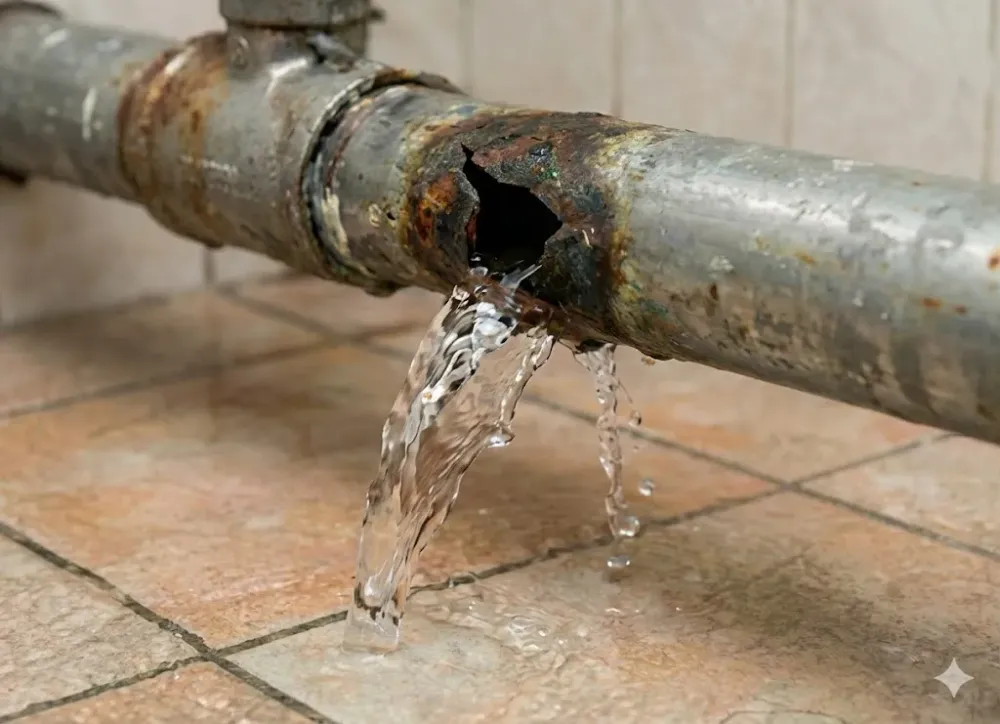
In Taiwanese residential buildings constructed prior to the 1990s, plumbing supply lines almost universally relied on galvanized iron piping. Decades of exposure to chlorinated municipal water consume the protective zinc coating, exposing the raw ferrous metal to accelerated oxidation. Over 25 years, iron oxide builds thick, jagged encrustations known as tubercles inside the pipe bore. The dark liquid discharged during pulse cleaning is not incoming silt; it is the structural wall thickness of your aging iron pipe being pulverized and stripped away.
Critical Hazards and Material Suitability
| Pipe Material | Building Age Profile | Pulse Cleaning Suitability | Recommended Engineering Strategy |
|---|---|---|---|
| SUS 304 Stainless Steel Press-Fit | Modern units or remodels under 15 years | Highly Safe & Effective | Stainless steel does not rust; pulse cleaning safely flushes biofilm, algae, and scale buildup. |
| PVC Cold Water Piping | Standard residential cold lines | Safe with Pressure Caps | Plastic piping resists rust; keep pulse pressure below 2.5 kg/cm² to avoid joint fatigue. |
| Galvanized Iron Pipes | Unrenovated apartments over 20 years | Extreme Hazard (High Risk) | Threaded joints are paper-thin. Pressure shocks crack pipe threads hidden in masonry. Solution: Replace with exposed or concealed SUS 304 piping. |
If an aging Taipei apartment suffers from rust-tinted water or restricted flow, investing in pulse cleaning carries catastrophic burst liabilities. The only sound long-term investment is re-piping with food-grade SUS 304 stainless steel tubing.