
One major advantage of buying a presale home over a newly completed one is that you can file a “customer change request” (“change request” for short) before the developer pours the floor slabs and installs piping in the partition walls. Many first-time buyers assume a change request only means choosing different paint colors or dropping unwanted partition walls, but what really shapes comfort and renovation budgets for decades is the advance layout of electrical circuits, water supply and drainage points, and low-voltage wiring. If you miss the developer's change-request window, then two or three years later, when you take handover and hire a renovation crew to chisel into RC walls and floors, add dedicated circuits, or relocate drain pipes, you will not only pay high costs for demolition, piping and tile restoration, but are also more likely to end up in disputes with the developer over waterproofing and piping and wiring warranty responsibility after handover.
Taiwan Presale Change Request: Wiring and Plumbing Review
This article is compiled from publicly available online sources for general reference only; readers should independently verify and judge its accuracy, and it is not legal, tax, medical or engineering advice. Rules, fees and subsidies change; check the latest notice from the responsible authority before acting. For electrical, gas, structural or health risks, consult a qualified professional.
This is the English edition of a Chinese article, adapted with AI assistance and checked against the original. Where the two differ, the Chinese version and the official sources it cites prevail.
1. Typical Add-and-Deduct Pricing for Presale Change Requests and Consumer Protection Reminders
There is no nationwide uniform deadline for accepting presale change requests. The actual window and submission deadline depend entirely on the developer's construction progress (usually after the basement structure is complete and before the standard-floor slabs are about to be built), the sale contract, and the written notice for your case. After receiving the developer's change-request notice, the buyer should immediately confirm the final submission deadline.
On pricing, many developers stipulate in their change-request rules that “only the pure material cost of work not yet carried out is refunded (labor is not refunded), while added items are charged per the developer's change-request price list plus a project management fee of roughly 5% to 15%.” But when reviewing the add-and-deduct breakdown, the buyer must clarify the following two important legal and consumer protection principles:
- “Materials refunded, labor not refunded” and the “management fee percentage” are contractual conventions, not legal requirements: The Ministry of the Interior's “Mandatory and Prohibited Provisions for Standard Presale Housing Sales Contracts” (預售屋買賣定型化契約應記載及不得記載事項) does not require developers to charge a 10% or 15% management fee for change requests, nor does it say only pure material cost may be refunded. If an item has not yet been procured or built when the change is made (for example, cancelling an interior brick wall or an entire bathroom set outright), yet the developer calculates the refund at a very low price while charging high management fees and unit prices for added items, creating a “refund little, charge much” gap that is manifestly unfair, or the developer cannot document actual administrative and drafting costs yet forfeits the entire labor cost, the buyer may still negotiate reasonable pricing with the developer under the good-faith principle of the Civil Code and Article 12 of the Consumer Protection Act, and if necessary file a complaint with the local government's consumer protection officer.
- Warranty and financial trade-offs of cancelling or changing bathrooms: Developers often state in the sale contract that “if the buyer cancels or changes bathroom fixtures, or has the waterproofing layer re-done in a second round of construction on their own, the developer is released from leak warranty responsibility for that part.” Therefore, before cancelling or changing a bathroom, calculate carefully the gap between “the developer's material refund” and “the full cost of finding your own crew after handover to redo masonry waterproofing, tiling and fixtures,” and confirm the warranty responsibility boundary in writing.
Below is an indicative add-and-deduct estimate range for a “standard 3-bedroom, 2-living-room condominium of 25 ping (1 ping ≈ 3.3 m²) in Taipei and New Taipei” (for rough budgeting only; actual amounts vary with piping run distance, switch panel brand, business tax, and the developer's contract terms):
| Change-request plumbing and electrical item | Typical refund (item not built) | Typical addition (new or relocated) | Planning and sale-contract points to confirm |
|---|---|---|---|
| Standard 110V two-pin grounded socket | Only the socket panel and partial wiring cost refunded (indicatively about NT$300–NT$600 per location) | Priced per the developer's change-request price list (indicatively about NT$1,500–NT$2,800 per location) | Locate precisely at the change-request stage the spots on both sides of the sofa back wall, above bedside tables, and at the desk and island, to reduce wall chiselling after handover |
| Dedicated circuits for high-power kitchen and balcony appliances | Original panel and material cost refunded | Priced by load specification and distance from the distribution board (indicatively about NT$3,500–NT$6,500 per circuit) | First confirm the appliance nameplate voltage (110V or 220V) and rated power, then have the developer's electrical staff set the wire gauge and breaker |
| Relocating water supply points and drain holes (not the soil pipe) | Original supply and drain fittings and faucet cost refunded | Priced by piping distance and any floor-raising needs (indicatively about NT$3,000–NT$6,000 per location) | Toilet soil pipes are limited by slab structure penetrations, building sewage design and the ownership of the unit below; for structural safety and regulatory reasons most developers do not allow large cross-zone relocation |
| Network outlets (Cat.6 / Cat.6A) and low-voltage outlets | Panel and wiring cost refunded | Priced by cable run length and cable grade (indicatively about NT$2,000–NT$3,800 per point) | If planning ceiling-mounted wireless access points (AP) for whole-home Wi-Fi roaming without dead spots, confirm the device supports PoE power and reserve a ceiling outlet |
| Reserving a neutral wire in switch boxes (neutral-and-live wiring) | No refund item | Usually treated as an “added point / wire-pulling item” priced separately (indicatively about NT$500–NT$1,200 per location, per the developer's quote) | In most Taiwanese developers' standard wiring, wall light switch boxes contain only a live wire and a control wire, with no neutral wire pulled; if you plan to install smart connected switches later, confirm at the change-request stage the unit price for adding a neutral wire and include it in the budget |
2. The 5 Most Commonly Overlooked Blind Spots in Presale Plumbing and Electrical Drawings
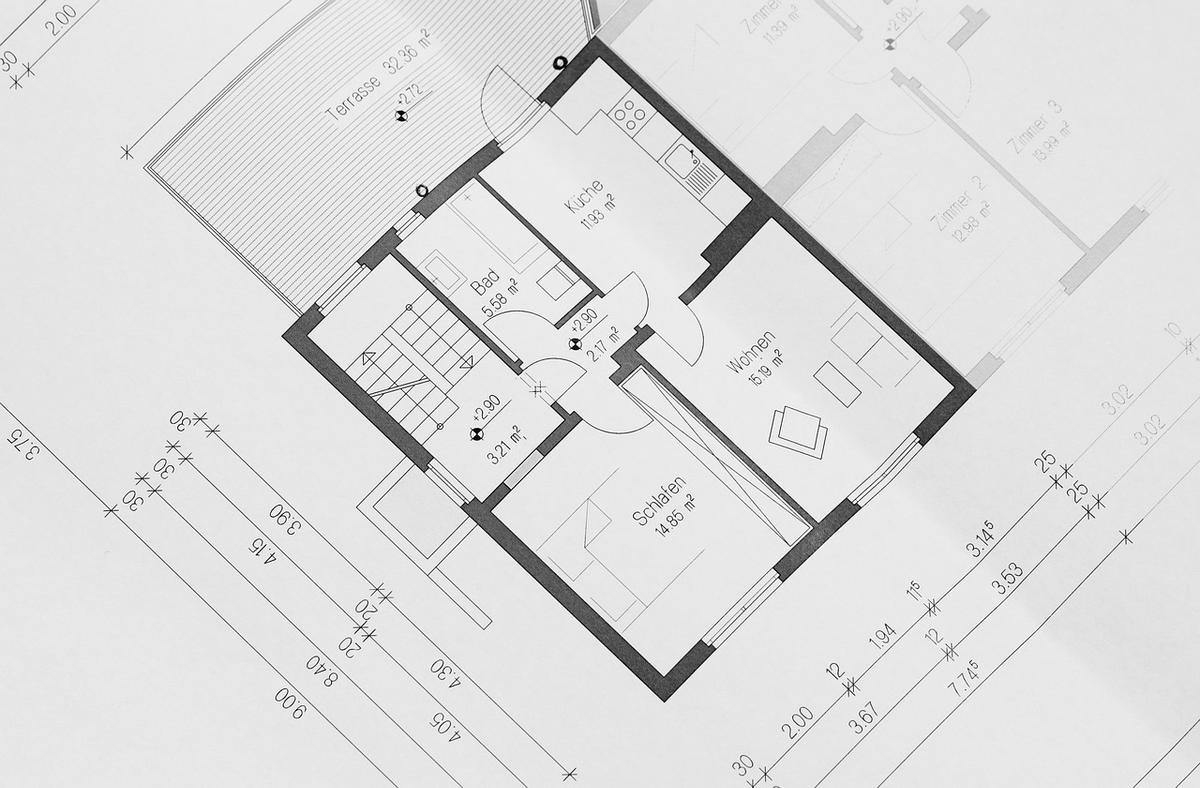
When you receive the developer's CAD drawings (including the standard-floor plan, the socket and low-voltage layout, the water supply and drainage equipment drawing, and the ceiling lighting and air-conditioning drainage drawing), owners are advised to check the following 5 daily-life pain points that modern households meet most often, one by one:
- Tally the simultaneous electrical load of the kitchen appliance cabinet and counter: The developer's standard drawings usually provide only 1 to 2 circuits of 110V / 20A in the kitchen appliance cabinet area. However, modern households preparing breakfast or dinner very often run a water-steam oven (about 1,400 W), an air-fryer oven (about 1,500 W) and an electric rice cooker (about 1,000 W) at the same time; the three together total as much as 3,900 W, and at 110V the total current is about: Formula:I = 3,900 W ÷ 110 V ≈ 35.45 AThis far exceeds the safe load of a single 20A circuit, so the breaker will inevitably trip often after move-in. Before the change request, list all appliances you plan to buy (including dishwasher, induction (IH) cooktop, oven and instant-heating water dispenser) and, according to nameplate voltage and the Regulations for Installation of Customer Electrical Equipment (用戶用電設備裝置規則), ask the developer to add independent dedicated circuits; pay particular attention that sockets for built-in European-style appliances (such as dishwashers and ovens) should be placed “inside the adjacent cabinet” rather than directly behind the machine, so the plug thickness does not push against the back panel and prevent a flush fit.
- Confirm the model and reserve piping for the robot mop's “automatic water supply and drainage”: In recent years more owners reserve a robot mop base position during the change request, but robot mop models by brand fall into “manual water tank type,” “external automatic water supply and drain kit,” and “built-in ultra-thin models,” each with very different requirements for inlet water pressure range, drain pipe diameter (commonly DN32 or larger rigid pipe or a dedicated drain hose), odor-proof P-trap / drain trap construction, and wall socket height (so the plug does not push against the machine's back panel). Before submitting drawings, select the target model and download the manufacturer's installation manual, then precisely reserve the matching cold-water angle stop valve (三角凡爾), drain hole and 110V socket on the utility balcony, behind the wall of the secondary bathroom, or under the entryway cabinet.
- Space limits of the low-voltage box (IT box) and planning a separate network equipment cabinet: The built-in low-voltage box the developer provides is usually inside the entry shoe cabinet and is shallow (commonly only about 10 to 15 cm deep). If you cram the Chunghwa Telecom fiber (光世代) modem, Wi-Fi router, PoE switch and home NAS storage server all into the small box and close the wooden cabinet door, poor heat dissipation easily causes frequent heat-related network crashes in summer and may even shorten the life of the transformers. A better practice is to reserve 2 power sockets inside the box for the fiber modem and main switch, and have the developer run concealed conduit to route network cables to a “separate network equipment cabinet” with ventilation louvers in the living room TV cabinet or study, where the main router and NAS are placed.
- Air-conditioner indoor unit airflow position and beam sleeve reservation: Check the developer's “air-conditioning drainage and refrigerant piping drawing” carefully and adjust the installation position of wall-mounted or concealed-ceiling indoor units, so cold air does not blow directly onto the bed head (affecting sleep health) or the main sofa seat in the living room. More importantly, if the refrigerant copper pipes and drain pipes must pass through a main structural beam of the building, have the developer's structural engineer assess it at the change-request stage and embed a “beam sleeve” before the slab is poured; once the embedding window is missed, after handover you must not drill or cut structural beams, columns or shear walls without structural professional assessment and the necessary approval.
- Electric curtain box and neutral wire reservation for smart home switches: If you plan plug-in electric curtains for the large floor-to-ceiling windows in the living room and the master bedroom, then according to the manual of the chosen motor brand, reserve a 110V socket or power outlet at the top of the left or right side of the curtain box (rechargeable lithium battery motors need no power cable, but must be removed and charged periodically). In addition, if you plan to install “smart wall switches (such as Wi-Fi / Zigbee / Matter connected switches)” in the future, be sure to ask the developer for a quote at the change-request stage and add a reserved “neutral wire (neutral-and-live wiring)” in each switch box, to avoid being limited later to less stable single-live-wire smart switches.
3. Evaluating Interior Designers for Change-Request-Only Services
If owners are busy or unfamiliar with reading CAD drawings, some interior design firms on the market offer “change-request-only planning services” (in some cases priced indicatively at about NT$2,000 to NT$3,500 per ping, or at a fixed project quote; some firms agree that if you later sign a full-home renovation design contract, the change-request fee may be credited in full or in part against the design fee, with specific conditions depending on the individual contract). Before signing a change-request engagement contract with a designer, confirm whether the scope fully includes: furniture-size layout drawings (to ensure sockets are not blocked by cabinets), CAD drawings of partition and electrical circuit changes, water supply and drainage point drawings, and the designer personally attending the developer's change-request meeting to check the add-and-deduct details and construction feasibility.
---
Related reading: Presale Home Customization: MEP Layout and Blueprint Tips · Presale House Piping Diagram and Wiring Verification Guide


