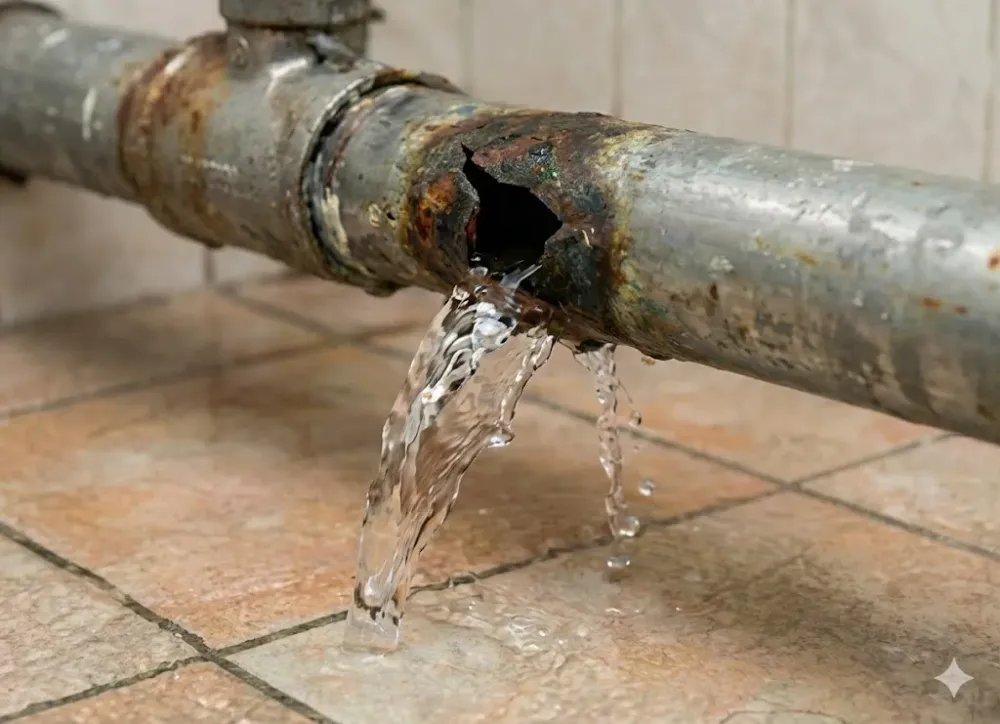
In older walk-up apartments and residential buildings aged 35 to 50 years across major Taiwanese metropolitan areas, early sewage stacks, toilet soil lines, and suspended ceiling drainage headers predominantly utilized heavy cast iron soil pipes (厚重鑄鐵排水管). Over decades of household wastewater corrosion, acidic or alkaline chemical cleaners, and high-humidity atmospheric oxidation in Taiwan, exterior pipe surfaces often develop large reddish-brown rust blisters. Pinhole punctures, hairline cracks, and persistent foul black wastewater leaks frequently erupt along the pipe underside or tee branch fittings. Completely demolishing and replacing these pipes with modern orange PVC foam-core pipes requires negotiating access with downstairs neighbors and spending tens of thousands of dollars. Mastering metal pipe repair clamps (哈夫節) combined with high-strength epoxy steel putty (塑鋼土) provides a permanent seal for under a thousand dollars without breaking walls!
Cast Iron Drain Pipe Crack and Rust Repair Clamp DIY
This article is compiled from publicly available online sources for general reference only; readers should independently verify and judge its accuracy, and it is not legal, tax, medical or engineering advice. Rules, fees and subsidies change; check the latest notice from the responsible authority before acting. For electrical, gas, structural or health risks, consult a qualified professional.
This is the English edition of a Chinese article, adapted with AI assistance and checked against the original. Where the two differ, the Chinese version and the official sources it cites prevail.
Safety and Toxic Gas Warning: When repairing overhead cast iron suspended pipes on stepladders, always wear a protective face shield, safety goggles, and heavy rubber gloves! Aged cast iron is heavy yet brittle; never strike pipe bodies aggressively with hammers while wire-brushing rust, as heavy blows can shatter thinned metal and cause sewage to burst out. Furthermore, if through-cracks develop, never rely solely on gray electrical PVC tape, as pipe pressure surges will dislodge tape within days!
1. Oxidation Mechanism of Cast Iron Punctures: From Surface Blisters to Full Breakthrough
While cast iron boasts outstanding acoustic dampening, fire resistance, and structural rigidity, its chemical corrosion resistance suffers two fatal vulnerabilities:
- Internal Acidic/Alkaline Waste and Hydrogen Sulfide Corrosion: Kitchen fatty acids, decomposed organic hair wastes, hydrogen sulfide (H₂S), and sewer biogas mists condense along pipe crowns into corrosive sulfurous and sulfuric acids, dissolving and thinning microscopic grain boundaries from the inside out.
- External Exfoliation Corrosion from Moisture: Leaking floor tiles above allow water to seep downward onto suspended ceiling pipes. When metallic iron oxidizes into iron oxide (Fe₂O₃), its volume expands 6 to 8 times, forming thick flaky red rust scabs. When internal acid thinning meets external exfoliation, the wall punctures completely.
2. Three Core Emergency Sealing Tools Without Wall Demolition
For localized pinholes and hairline cracks without structural collapse risk, professional plumbers rely on this three-part system:
- Stainless Steel Pipe Repair Clamp (不鏽鋼管道修補抱箍 / Half-Clamp): Built from thick SUS 304 stainless steel sheet armor, heavy-duty bolts, and an internal full-coverage waffle-patterned NBR or EPDM watertight rubber gasket. Clamped around the puncture and tightened with a torque wrench, the elastomer gasket is forced under radial tension into metal micro-pores, resisting 5 to 10 kgf/cm² working pressure with lasting seismic flexibility.
- Epoxy Steel Repair Putty (塑鋼土): A two-part compound heavily packed with steel powder and epoxy resin. When parts A and B are mixed 1:1, it bonds to metal surfaces and polymerizes within 30 minutes into a rigid steel-hard mass that withstands heat, water, acids, and alkalis, and can be drilled or ground.
- Self-Fusing High-Pressure Silicone Repair Tape (自融自粘性矽膠防水膠帶): Stretches up to 300% to bond to itself without adhesive, acting as an elastic buffer layer under repair clamps.
3. Four-Step DIY Guide to Sealing Punctured Cast Iron Drain Pipes
Prepare a wire brush, sandpaper, degreaser, epoxy steel putty, and appropriately sized metal repair clamps:
- Shut Off Upstream Water and Thoroughly Remove Rust: Notify upstairs neighbors to pause water use for 1 hour. Use a wire brush or steel scraper to thoroughly strip loose rust flakes and blistered paint within a 15 cm radius around the puncture. Scour with 80-grit coarse sandpaper until bright metal appears, then wipe with solvent degreaser to remove grease and carbon powder.
- Knead and Pack Epoxy Steel Putty Over the Hole: Mix equal portions of Part A and Part B putty with gloved hands for 2 to 3 minutes until uniform in color and warm to the touch. Press the putty firmly into the puncture cavity while pliable, feathering edges outward across 3 to 5 mm thickness. Allow 30 minutes to cure into a rock-hard layer.
- Install Stainless Steel Repair Clamp (Structural Reinforcement):
- Measure the pipe outside diameter (typically 2-inch approx. 60 mm, 3-inch approx. 89 mm, or 4-inch approx. 114 mm), purchasing a clamp of matching diameter (recommended length 15 to 20 cm).
- Open the rubber-lined stainless clamp around the putty-patched zone, positioning the bolt split away from the puncture. Alternately tighten side bolts 1/2 turn at a time until the rubber gasket compresses firmly and extrudes slightly at edges.
- Apply Anti-Rust Coating for Extended Life: Spray two coats of zinc-rich cold galvanizing paint or epoxy anti-corrosion enamel over the repair zone and surrounding bare metal to halt ongoing moisture oxidation.
4. Emergency Clamp Repair vs Full PVC Replacement Comparison
| Repair Method | Applicable Damage Extent | Leak Sealing Durability | Total Project Cost (TWD) | Construction Impact & Neighbor Coordination |
|---|---|---|---|---|
| Stainless Steel Clamp + Epoxy Putty | Localized pinholes, hairline cracks | 5 to 10+ years (Extremely solid) | Approx. NT$350 - NT$600 (DIY materials) | Zero dust, zero noise; done in 30 minutes |
| Local Section Cut & PVC Replacement | Single pipe segment heavily punctured | Over 15 years | Approx. NT$6,000 - NT$12,000 (Plumber labor) | Requires grinder cutting; odors and noise |
| Full Building Main Soil Stack Replacement | Severe thinning with collapse risk | Over 30 years | Approx. NT$30,000 - NT$80,000 per unit | Requires all co-owners funding & downstairs access |
| Wrapping with Gray Tape or Seal Tape Alone | Temporary emergency triage | Approx. 3 to 7 days (Bursts under pressure) | Approx. NT$50 | Ineffective self-deception; strictly prohibited |
5. Official Standards and Condominium Maintenance Responsibilities
Drainage piping materials must comply with Ministry of Economic Affairs Bureau of Standards, Metrology and Inspection CNS 1080 Cast Iron Soil Pipes and Fittings and CNS 14214 standards. Regarding maintenance liability, under Article 12 of the Condominium Administration Act (公寓大廈管理條例), piping embedded in common floors or serving shared utilities involves joint responsibility between upstairs and downstairs co-owners, while main vertical soil stacks belong to common property maintained by the management committee (管委會).
Related references: Galvanized Iron Pipe Yellow Rust Water Pipe Cleaning Guide, and Sink Wall Drain P-Trap Pipe Replacement and Escutcheon Seal Guide.
6. Frequently Asked Questions FAQ
Q1: Can water pipe leak repair tape or rubber bands alone stop leaks?
No! Standard electrical tape or garden hose tape lacks sufficient compressive strength and chemical resistance against sewage biogas. Within days, wastewater seeps beneath the tape, accelerating hidden corrosion underneath until explosive rupture occurs.
Q2: What if the leak is located on an irregular tee or 90-degree elbow joint?
Straight pipe clamps cannot conform to curved fittings. For elbows or tees, use fiber-reinforced water-activated fiberglass cast bandages (pipe repair wrap) layered with epoxy putty, wrapping 6 to 8 tight layers directly over fittings to cure into a rigid composite shell.
Q3: If a vertical soil stack is leaking, can downstairs residents refuse entry?
Under Article 6 of the Condominium Administration Act, owners have an obligation of tolerance allowing access for maintenance. If neighbors refuse cooperation, the management committee or local district office mediation committee can intervene, or court injunctions can compel access.
Q4: How can one determine whether cast iron pipes are completely deteriorated?
Tap the pipe body gently with a wooden mallet: a clear metallic ringing sound indicates sound structural thickness, whereas a dull thud or crumbling surface flakes indicates advanced wall loss under 2 mm, requiring full pipe replacement rather than local clamping.