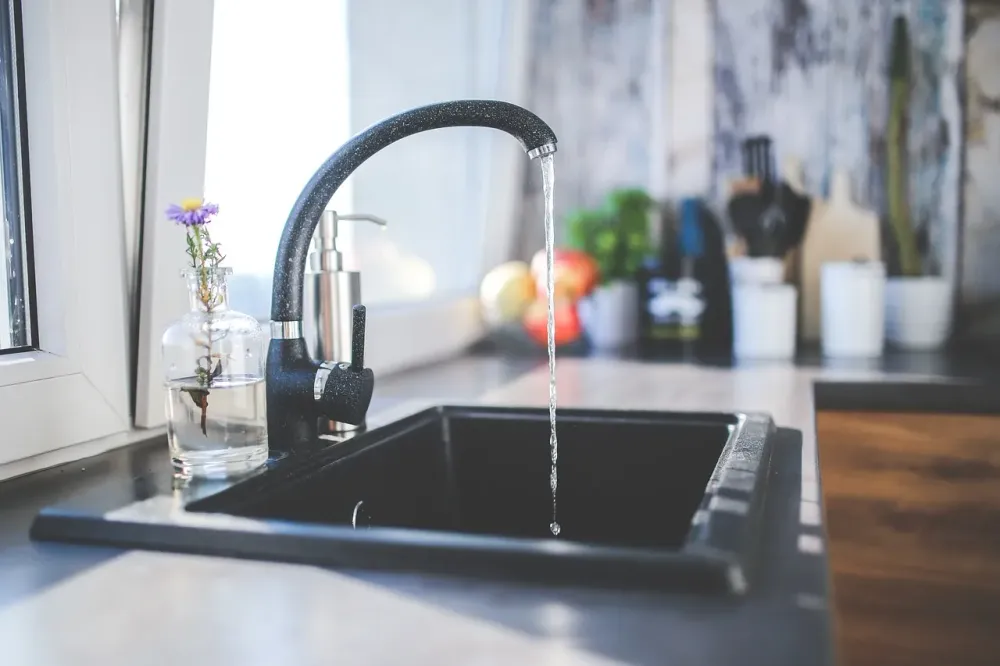
In modern kitchens, pull-out and pull-down sink faucets that extend freely to rinse sink corners and large stockpots are standard fixtures. However, after period of use, homeowners often face frustrating issues: after pulling the spray head out to wash dishes, the hose jams mid-air and refuses to retract, or pulling it feels stiff and resistant. Many assume an internal spring broke, but pull-out faucets contain zero springs. Smooth automatic retraction relies entirely on a gravity counterweight suspended beneath the sink. Clearing dark under-cabinet tangles and adjusting the counterweight restores effortless retraction.
Looking for the Chinese version of this article?切換至繁體中文版 →
Pull-Out Faucet Hose Stuck: Counterweight and Retraction Fix
This article is compiled from publicly available online sources for general reference only; readers should independently verify and judge its accuracy, and it is not legal, tax, medical or engineering advice. Rules, fees and subsidies change; check the latest notice from the responsible authority before acting. For electrical, gas, structural or health risks, consult a qualified professional.
This is the English edition of a Chinese article, adapted with AI assistance and checked against the original. Where the two differ, the Chinese version and the official sources it cites prevail.
Installation and leak warning: When working under the sink to inspect retractable hoses, never jerk violently on metal braided hoses. Lateral impact on quick-connect fittings between hoses and brass outlet tubes can shatter brittle plastic clips, causing pressurized water to flood the kitchen. Always close cold and hot angle stop valves before servicing.
1. Mechanics of Faucet Retraction: Gravity Counterweight Principles
Pull-out faucet mechanics operate on a straightforward gravity pulley counterweight system:
- U-shaped hose travel track: The high-pressure braided hose connects to the spray head, threads through the faucet gooseneck, drops below the sink countertop into a suspended U-bend loop, and loops back up to click into the mixed-water outlet tube via quick-connect fittings.
- Function of the gravity counterweight: Clamped to one leg of the U-loop (typically the spray head side). Pulling the spray head above lifts the counterweight, storing potential energy; releasing the spray head allows the weighted block to drop by gravity, pulling the hose and spray head back into the spout collar.
2. Three Common Causes of Jammed Faucet Hoses
Approximately 95% of hose retraction friction originates in dark, cluttered under-sink cabinets:
- Obstructions from pots, pans, and detergent bottles: Cabinets crowded with dish soap bottles, water filter cartridges, and cookware obstruct the hose. As the hose moves, it snags against pot edges or containers, preventing the counterweight from dropping freely.
- Counterweight clamped at incorrect positions or heights:
- Clamped too high: Pulling the hose just 10 cm causes the counterweight to collide with the underside of the countertop, blocking further extension.
- Clamped too low: The counterweight rests flat on the cabinet floor, losing its hanging gravitational pull and leaving the spray head dangling loosely.
- Entanglement with water supply lines or corrugated drain pipes: Braided nylon or corrugated stainless hose jackets twist against nearby hot/cold supply lines or drain pipes during rotation, multiplying friction.
3. Four Steps to Adjust Counterweights to the Golden Position
Follow these steps beneath the sink to adjust counterweights for smooth retraction:
- Clear the under-sink cabinet space: Remove all cookware and cleaning supplies from beneath the sink, illuminating the cabinet with a flashlight to trace the full U-bend path.
- Loosen counterweight mounting screws: Counterweights consist of two cast-iron halves encased in plastic, secured by 2 Phillips screws. Loosen the screws to detach the weight.
- Locate the ideal mounting position:
- Ensure the spray head above sits completely docked inside the faucet spout collar.
- Climb beneath the sink and locate the lowest curve of the hanging U-loop.
- Clamp the counterweight on the spray head hose leg, approximately 5 to 8 cm above the lowest point of the U-bend (some hoses mark this with a white "Weight Here" label).
- Tighten the clamping screws firmly.
- Full travel extension test: From above, extend the spray head to maximum reach, verifying the rising counterweight avoids catching on stop valves; releasing it should snap the head back into dock smoothly.
4. Troubleshooting Guide for Pull-Out Faucet Friction and Docking Issues
| Failure Symptom | Root Mechanical Cause | DIY Troubleshooting Procedure | Replacement Parts Cost | DIY Difficulty |
|---|---|---|---|---|
| Pulls out smoothly but sags without retracting | Counterweight rests on cabinet floor without hanging tension | Move counterweight 10 cm higher and clamp securely | NT$0 (screwdriver adjustment) | Very easy (5 minutes) |
| Hose jams after pulling out only slightly | Counterweight set too high or hose tangled with pipes | Untangle lines and shift counterweight downward slightly | NT$0 (organizing conduit space) | Simple (re-routing lines) |
| Loud metallic grating noise when pulling hose | Dry friction between braided hose and faucet guide collar | Wipe small amounts of silicone grease along the hose | NT$50 (food-grade silicone grease) | Simple (lubrication) |
| Spray head does not dock flush, drooping slightly | Magnetic docking ring de-glued or demagnetized | Replace spout plastic sleeve or reinstall magnetic collar | NT$80 to 150 | Moderate (requires collar removal) |
5. Official Plumbing Standards and Material Inspection Codes
Kitchen faucet drinking water safety must comply with BSMI standard CNS 8088 (Water Faucets) heavy metal leaching limits (LF lead-free certification). Retractable hose pressure resistance follows BSMI standard CNS 15844 sanitary supply hose 10 kgf/cm² burst pressure specifications.
Explore more kitchen hardware guides: kitchen sink basket strainer anti-odor replacement guide and adjusting sagging soft-close cabinet hinges.
6. Frequently Asked Questions
Q1: The cabinet is cramped and the hose collides with drain pipes. How can I fix it?
Install a conical hose guide funnel under the sink. Premium faucets include flared plastic guides that constrain the hose to slide vertically without swaying. Alternatively, wrap a length of slit corrugated conduit over the hose to prevent snagging against sharp angle valves.
Q2: Why does moisture leak along the retractable hose, causing under-sink mold?
Retractable hoses feature internal EPDM or silicone tubes sheathed in stainless steel or nylon. Over-extending and sharply kinking hoses while washing pots creates fatigue micro-cracks in rubber cores. Test by wrapping a dry paper towel around the hose while running water; moisture indicates perforation requiring hose replacement.
Q3: Can I add a heavier counterweight if factory retraction feels sluggish?
Avoid excessive counterweight (such as exceeding 600 grams). While retraction speeds increase, pulling the head becomes fatiguing on wrists, and aggressive snap-back impacts damage plastic docking sleeves and loosen deck mounting nuts. Sluggishness usually indicates incorrect positioning or friction rather than insufficient weight.
Q4: What if the spray pattern selector button jams and cannot toggle?
In hard water regions, calcium scale deposits jam internal micro-valves. Unscrew the spray head and submerge it in a warm 10% citric acid solution for 30 minutes. Press the toggle button repeatedly while soaking to dislodge limescale and restore crisp button actuation.
Related reading: Kitchen Pull-Out Faucet Hose Leaks: DIY Replacement