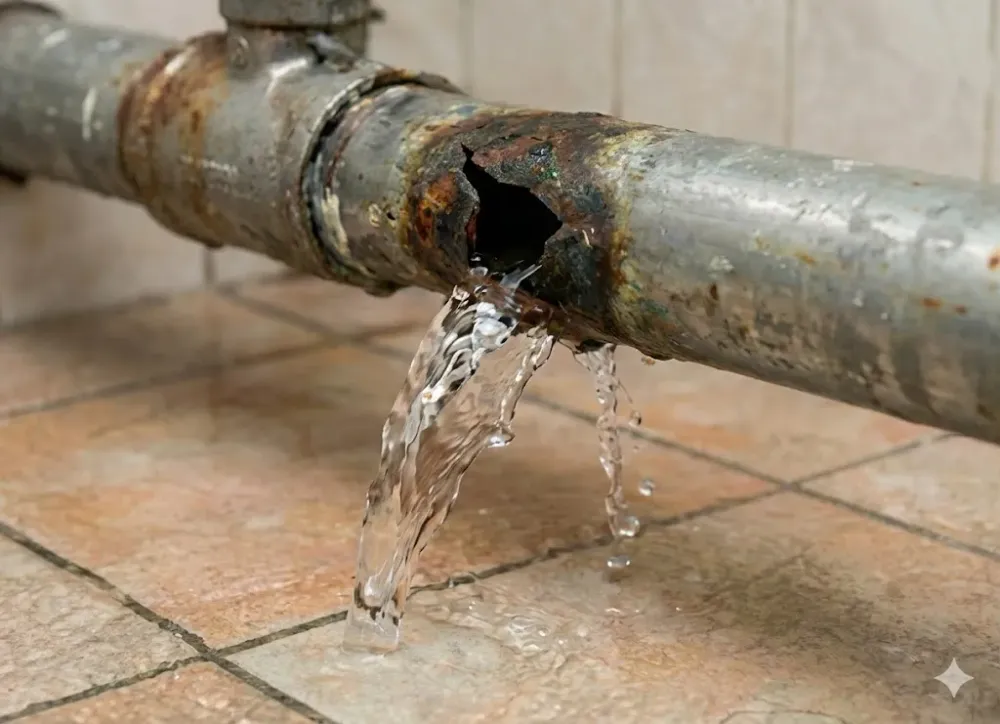
When a metal roof leaks along indoor walls only in heavy rain, it is usually an overflowing gutter rather than a hole in the roof: if water appears only in heavy rain, along wall or ceiling edges, suspect a gutter clogged with leaves and silt that is backing up. Cleaning the gutter and the downspout inlet usually improves things. Replacement is needed only if the gutter has rusted through, the slope runs the wrong way, or the downspout is too small. Roof work carries risks of falling through the roof and falling off it, so all cleaning in this article is limited to places you can reach safely. For roof drains and leaf guards on RC rooftops, see Extreme Rainstorm Roof Drain Leaf Guard and Basement Check Valve Inspection. This article covers only the gutters and downspouts of metal roofs.
Metal Roof Gutter Overflow Leaking Indoors: Cleaning Guide

This article is compiled from publicly available online sources for general reference only; readers should independently verify and judge its accuracy, and it is not legal, tax, medical or engineering advice. Rules, fees and subsidies change; check the latest notice from the responsible authority before acting. For electrical, gas, structural or health risks, consult a qualified professional.
This is the English edition of a Chinese article, adapted with AI assistance and checked against the original. Where the two differ, the Chinese version and the official sources it cites prevail.
How to tell gutter overflow from a leaking roof
Look at when and where the water appears first, then decide whether anyone needs to go up on the roof. If all three signs appear together, gutter overflow is very likely.
Leaks only in heavy or prolonged rain
If it does not leak in light rain but does in heavy rain or after several days of rain, drainage cannot keep up, and water backs up over the gutter edge or seams once the level rises. If the roof itself had a hole, it would usually drip even in light rain.
Leaks along the eaves or walls
Water marks gathered where the exterior wall meets the roof, along ceiling edges, or above windows, rather than in the middle of the roof, mostly match the gutter position. When an inner gutter (one that sits between the roof and the wall) overflows, the water runs straight down the inside of the wall.
Stops soon after the rain stops
Water from an overflowing gutter drains away quickly, so the dripping stops soon after the rain ends. If it keeps dripping long after the rain stops, look at the roof seams, fixing screws, or the junction with the parapet wall.
| What to observe | More like gutter overflow | More like a roof leak |
|---|---|---|
| When it happens | Leaks only in heavy or prolonged rain | Drips even in light rain |
| Location | Along the eaves, walls, ceiling edges | Middle of the roof, directly below screws or seams |
| After the rain stops | Stops quickly | Keeps dripping for a while |
| Inside the gutter | Leaves and silt, standing water that does not drain | Gutter is clear but still leaks |
When checking inside the gutter, look from a second-floor window, a balcony, or a firmly set ladder. Do not step onto the roof to get a better view.
Cleaning gutters and downspouts
How often and when to clean
There is no official uniform rule on cleaning frequency. We suggest checking once before the rainy season and once after each typhoon. For roofs with many nearby trees, or next to a construction site or construction dust, you can clean earlier depending on how much has built up.
Downspout inlet and elbow
Clogs most often form at the downspout inlet and the first elbow, where leaves, silt, plastic bags and bird nests get stuck. For an inlet you can reach from a safe position, wear gloves and scoop the debris out. If it is beyond arm's reach, or you would have to step onto the roof or lean over the edge, do not handle it yourself.
Testing drainage speed with water
After cleaning, run a hose from a safely reachable position at the gutter inlet and watch two things: whether the water level in the gutter keeps rising, and whether water flows freely out of the downspout outlet. A rising water level or a thin trickle at the outlet means there is still a clog or the pipe is too small. During the test, also make sure the water does not spray directly onto the neighbor's land.
Pre-rainy-season checklist
- Is there a build-up of leaves, silt, plastic bags and similar debris in the gutter?
- Is the downspout inlet covered by debris, and is the outlet clear?
- Do the gutter seams show peeling glue, lifting, or signs of seepage?
- Does the bottom of the gutter show rust spots, blistering, or holes?
- Are there old water marks on the ceiling and along the walls, and are they below the gutter?
- During the water test, does the water level in the gutter rise abnormally?
Before the rainy season you can also combine this with the 24-Hour Pre-Typhoon Home Inspection Checklist, and use the rain radar tool and the typhoon tracker tool to follow when the rain will arrive.
Still overflowing after cleaning: problems with the gutter itself
Rust holes and peeling seams
A gutter that holds standing water for long periods tends to rust from the bottom and the seams. Rusted-through holes and peeling seams let water seep along the wall, and this kind of leak happens whether or not there is a clog. For a small rust spot, the installer can assess rust removal and repainting. If the rusted area is large or the sheet metal has thinned, the whole section usually has to be replaced.
Insufficient or reversed slope
A gutter must keep a drainage slope toward the downspout. If after cleaning the water still sits in the middle of the gutter without flowing, or one section keeps holding water after the rain stops, the slope may be insufficient, the support may have sunk, or the gutter may have been installed in the wrong direction from the start. This needs to be readjusted or rebuilt and cannot be solved by cleaning.
Too few or too narrow downspouts
If the roof area is large but there are few downspouts of small diameter, the water volume in heavy rain exceeds drainage capacity and will overflow even when the pipes are clear. For design drainage capacity and downspout layout, you can refer to the building water supply and drainage equipment design technical specifications published by the 內政部國土管理署 (Construction and Planning Agency, Ministry of the Interior). To add pipes or enlarge their diameter, have an installer assess on site based on the roof area and gutter size.
Ways to prevent clogs and improve drainage
Leaf guards and overflow outlets
Fitting a leaf guard at the downspout inlet reduces the leaves that get into the pipe, but the mesh itself also collects debris and still needs regular clearing. Another approach is to add an overflow outlet on the outer side of the gutter, so that if the inlet blocks, water goes out of the building first instead of backing up indoors. The position and direction of the overflow outlet should avoid pouring directly onto the neighbor's land and should stay clear of walkways.
Converting an inner gutter to an outer gutter
When an inner gutter overflows, the water flows into the interior, while an outer gutter mostly overflows outward and affects the interior less. But converting to an outer gutter involves the eave structure, roof edge finishing, and rerouting the downspout, and it may also affect appearance and neighboring drainage. The installer needs to assess the roof frame and the original construction instructions before deciding, and you should first confirm whether your community or building rules allow changes to the exterior.
Links to the same series' comparison of roof waterproofing materials and to the treatment of water seeping through rooftop-addition walls will be added once those articles are published. For upgrading drain pipes on balconies and stairwells, see the Taipei Thunderstorm Balcony Drainage Pipe Upgrade Guide.
Safety limits: what not to do yourself
Metal roof sheets and skylight panels have limited load capacity, so they are easy to step through, and even easier to slip on when wet. The Occupational Safety and Health Administration of the 勞動部 (Ministry of Labor) publishes awareness material on preventing falls caused by stepping through roofs. The table below separates what residents can do themselves from what needs an installer. Under no circumstances should you step on a metal roof sheet or skylight panel.
| Item | Residents can do themselves | Leave to roofing or plumbing installers |
|---|---|---|
| Gutter cleaning | Debris within reach from a window, balcony or a stable position | Any part that requires going onto the roof, leaning over the edge, or using an unstable ladder |
| Downspout | Clearing the ground-level outlet, scooping debris from a low inlet | Clogs at high elbows, removing or reinstalling pipes |
| Leaf guard | Cleaning and replacing at low, reachable positions | Fitting on the high roof, cutting overflow outlets |
| Gutter repair | None, observation and records only | Rust removal, redoing seams, adjusting slope, replacing a whole section |
| Roof sheet and skylight panel | None, do not step on them | All inspection and work |
Do not go up on the roof during thunderstorms, strong wind, or when the roof is wet. When you need a contractor to come, first photograph the water mark locations and the water test results to make explaining easier.
FAQ
How often should the gutter be cleaned?
There is currently no official uniform cleaning frequency. We suggest checking once before the rainy season and once after each typhoon, and cleaning earlier in leafy surroundings depending on the build-up.
Can a hole in the gutter be patched with silicone?
A small hole can be treated as a temporary stop to the leak, but a gutter that sits in water for long periods and expands and contracts with heat tends to make silicone peel off, and the metal around the rust may already have thinned. If the hole is large or keeps coming back, have an installer assess repair or replacement, and the work should be done under safe conditions.
How do I clear a blocked downspout?
Check from the ground-level outlet first. You can flush upward from the outlet with a hose, or clear it with a flexible drain snake. Do not jab hard objects in forcefully, to avoid puncturing the pipe wall, and avoid corrosive chemicals that damage the pipe material. If the blockage is at a high elbow, or clearing does not work, call a contractor.
Am I responsible if gutter water drains onto the neighbor's property?
Article 777 of the 民法 (Civil Code) provides that a landowner may not build eaves or other structures that cause rainwater to pour directly onto adjoining real estate. The outlet direction of gutters and downspouts should avoid draining straight onto neighboring land. Actual responsibility is still decided case by case. If there is already a dispute, we suggest keeping photos and communicating in writing, and if necessary consulting a lawyer or applying to a mediation committee for mediation.
Sources
- Construction and Planning Agency, Ministry of the Interior: building water supply and drainage equipment design technical specifications (verified 2026-11-11): for the design principles of roof rainwater drainage and downspout layout; actual pipe diameter and number still need on-site assessment.
- Occupational Safety and Health Administration, Ministry of Labor: awareness material on preventing falls from stepping through roofs (verified 2026-11-11): explains the risks of stepping through and falling during roof work, and is the basis for this article's rule against stepping on the roof.
- Laws and Regulations Database: Civil Code Article 777 (verified 2026-11-11): eaves or structures may not cause rainwater to pour directly onto adjoining real estate.