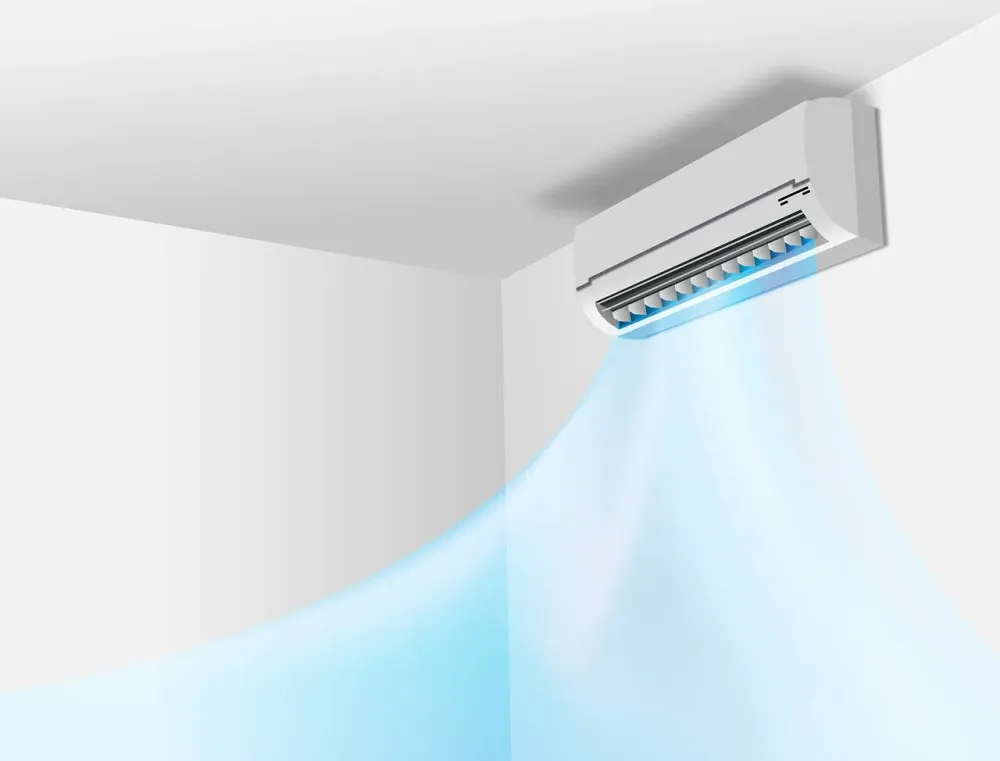
On a hot night, many people are woken by dripping from the AC above the bed, only to find water leaking from the lower edge of the indoor unit's air outlet, sometimes streaming down the wall like a small waterfall and soaking wallpaper, expensive solid-wood flooring and bedside electrical devices. When an indoor unit suddenly leaks heavily, more than 90% of the time it is neither a refrigerant leak nor a cracked casing. Instead, a thick, jelly-like biofilm (bacterial slime, 泥藻) has grown in the condensate drain pan and drain hose and completely blocked the drain opening, which is only 16 mm in inner diameter, so the condensate has nowhere to go and overflows back out.
Looking for the Chinese version of this article?切換至繁體中文版 →
Indoor AC Unit Leaking Water: Unclog the Drain Line
This article is compiled from publicly available online sources for general reference only; readers should independently verify and judge its accuracy, and it is not legal, tax, medical or engineering advice. Rules, fees and subsidies change; check the latest notice from the responsible authority before acting. For electrical, gas, structural or health risks, consult a qualified professional.
This is the English edition of a Chinese article, adapted with AI assistance and checked against the original. Where the two differ, the Chinese version and the official sources it cites prevail.
Warning: when the indoor unit starts dripping or spraying water, the first step is to switch it off with the remote control right away, then go to the breaker box and turn the AC's dedicated no-fuse breaker (NFB, 無熔絲開關) fully to OFF. Never let condensate reach the inverter electrical control box on the right side of the indoor unit or an extension cord on a wall socket below it. A short circuit can burn out a main board costing thousands of NT dollars or start a fire.
1. How the Indoor Unit Collects Condensate: From Fin Condensation to the Drain
When a split AC runs in cooling mode, low-temperature refrigerant circulates through the aluminum fins of the evaporator in the indoor unit. As the cross-flow fan pulls warm, humid room air across the fins, water vapor condenses into droplets (running the unit 8 hours a night can produce as much as 5 to 10 liters of condensate).
The droplets run down the aluminum surface into the plastic condensate drain pan below. A slight slope of about 1% lets gravity carry the water to the drain fitting in the corner, and from there it leaves through a clear PVC hose of 4-fen or 5-fen size (about 14-18 mm in diameter) to the outdoors or to a bathroom drain. The system relies entirely on gravity flow with no mechanical pressure, so even a small obstruction at the throat of the line will stop the flow and make the water overflow.
2. Why Jelly-Like Slime Forms, and What Not to Pour In: Chemical Drain Cleaner and Bleach
Many homeowners ask: isn't condensate nearly distilled water? Why does a sticky black-and-yellow, snot-like slime grow in it?
- How the biofilm forms: The air carries countless invisible airborne dust particles, skin flakes, pollen and mold spores. Drawn into the unit and soaked in the cold, damp drain pan, this organic matter becomes an ideal breeding ground for cold-loving slime-forming bacteria (such as Sphingomonas). The bacteria secrete large amounts of extracellular polysaccharide polymers (EPS) that cross-link and wrap around themselves into a tough, viscoelastic, jelly-like slime.
- Never use chemical drain cleaner: Never pour store-bought flake-type strong alkaline drain cleaner (sodium hydroxide) into the AC drain pan! Strong alkali gives off intense heat on contact with cold water (up to 90°C) and will melt straight through the thin plastic drain pan and the foam insulation. Unreacted chemical granules can also harden and clump in the cold pipe, ruining the drain line for good.
3. Using a Manual Vacuum Unclogger at the Outdoor Drain Outlet: the Correct 3 Steps
The most effective DIY fix, with no disassembly and no expensive service call, is to buy a manual vacuum unclogger made for AC drain lines (a suction pump, about NT$150-300) from a hardware store or online:
- Find the end of the outdoor drain hose: On the balcony floor, on the exterior wall or next to a rainwater downpipe, find the outlet of the clear or black drain hose that runs from this indoor unit.
- Seal it tightly (the key point): Push the unclogger's angled rubber sealing tip firmly onto the outdoor drain outlet and hold it at the seal so that it is 100% airtight with no air leaking.
- Pull only, never push: pull quickly (the core rule):
- Grip the handle and pull it outward hard and fast 2 to 3 times, so the strong vacuum draws the jelly-like slime out of the pipe!
- Never push air into the pipe with force! If you push air inward, the strong pressure will blow the dirty, foul-smelling water stored in the pipe back out of the indoor unit and onto your living-room ceiling, sofa and the AC's circuit board.
- After you pull, take the pump off. Liters of dirty water and yellow-black lumps of slime will gush out of the pipe, and once it has drained, the indoor unit stops leaking immediately.
4. Removing and Cleaning the Drain Pan, and Placing Antibacterial Tablets to Prevent Recurrence
The full maintenance routine to stop the biofilm coming back for good:
- Remove the indoor unit's front cover, loosen the clip bolts on both sides that hold the drain pan with a Phillips screwdriver, and carefully lift out the long drain pan.
- Using diluted baking soda water or mild dish detergent, scrub the black mold and grime out of the pan's channel with a soft brush, then rinse with clean water.
- Place slow-release anti-mold, antibacterial tablets made for air conditioners (drain pan tablets): Stick 1 to 2 tablets at the end of the pan farthest from the drain outlet. When the tablets contact condensate they slowly release long-lasting disinfecting ions that kill bacteria in the pan for 6 to 12 months, stopping the jelly-like biofilm from forming again at its source.
5. Table: Clogged Drain vs Insufficient Slope vs Cracked Insulation
| Type of leak | Where the water appears and what it looks like | Main cause | Standard remedy |
|---|---|---|---|
| Biofilm clogging the drain line (most common) | The drain pan at the bottom of the indoor unit is full and water pours in large drops from the air outlet | The throat of the drain line is packed with jelly-like slime | Suction with a manual vacuum unclogger |
| Insufficient drain slope (water flowing uphill) | Leaks slowly only after the AC has been running for 2 hours | The concealed copper drain line lacks the 1% slope, or sags in the middle | Re-level the indoor unit's mounting plate or fit a drain pump |
| Cracked drain-line insulation causing condensation | Water seeps along the path of the pipe hidden in the wall and leaves a local patch of wall efflorescence and peeling (壁癌) and water stains | The drain line has no outer insulation, so cold wastewater makes the air condense on it | Fit closed-cell foam insulation sleeves on the drain line |
| Ice on the heat exchanger fins melting | Ice flakes blow out of the air outlet, and a large amount of ice water melts out right after the unit is switched off | A filter left unwashed for years chokes the airflow, or a refrigerant leak drops the system pressure | Deep-clean the filter and evaporator, and have a technician do leak detection and recharge the refrigerant |
6. Refrigeration and Air-Conditioning Standards and Official Anti-Leak Guidance
Drain pipe slope, pipe diameter and watertightness testing for air-conditioner condensate should follow the standard CNS 2060, Window-Type and Split-Type Air Conditioners (窗型與分離式空氣調節機) of the Bureau of Standards, Metrology and Inspection (BSMI), Ministry of Economic Affairs (經濟部標準檢驗局). For installation technical guidelines for AC work, see the technical manuals of the Taiwan refrigeration and air-conditioning engineering industry association (台灣冷凍空調工程工業同業公會).
More on AC cleaning, maintenance and leak prevention: Common Causes of Air Conditioner Faults and Repair Budgets, and How to Insulate an AC Drain Pipe to Stop Dripping.
7. Frequently Asked Questions
Q1: Can I blow into the drain pipe with my mouth to clear it?
Absolutely not! The inside of an AC drain pipe is full of slime containing high concentrations of mold, Legionella, cold-loving bacteria and other disease-causing microorganisms. Blowing into it by mouth can very easily make you inhale deadly bacteria and cause severe pneumonia or a fungal infection. Blowing also sends all the dirty water spraying back onto the indoor ceiling and furniture. You must use a dedicated manual vacuum pump.
Q2: Is it better to install the indoor unit tilted sharply toward the drain outlet so it drains more easily?
Completely wrong! The drain pan of a modern split AC is molded with a precise built-in drain slope. When the metal mounting plate for the indoor unit is installed, it must be calibrated with a bubble level to be perfectly level! If the whole unit is visibly crooked, condensate can instead spill over the edge of the secondary pan on the lower side and leak out from the other end of the unit.
Q3: I have a "Little Water Sprite" (小水精靈) automatic AC drain pump. Why is it making a loud clattering noise?
An electric drain pump contains a small float switch and a miniature pump motor. A sharp, loud clattering is usually caused by the float mechanism being jammed with jelly-like slime, which makes the micro switch flick on and off rapidly, or by the gear shaft running dry and wearing out. You need to open the casing and clean the float, or replace the pump with a fully silent, extra-durable one (about NT$800-1,500).
Q4: Can I pour diluted bleach into the AC drain pan to kill the slime?
You can use a very small amount, but be extremely careful! Dilute sodium hypochlorite bleach with water at 1:50, then add it slowly to the drain pan with a syringe or a small watering can. It can quickly oxidize and dissolve the slime. But never use undiluted concentrate, and do not let it splash onto the copper pipes or aluminum fins, or the hypochlorous acid can corrode the metal walls and cause a refrigerant leak through pinholes.
Related reading: AC Condensate Pump Overflowing or Buzzing: Clean or Replace