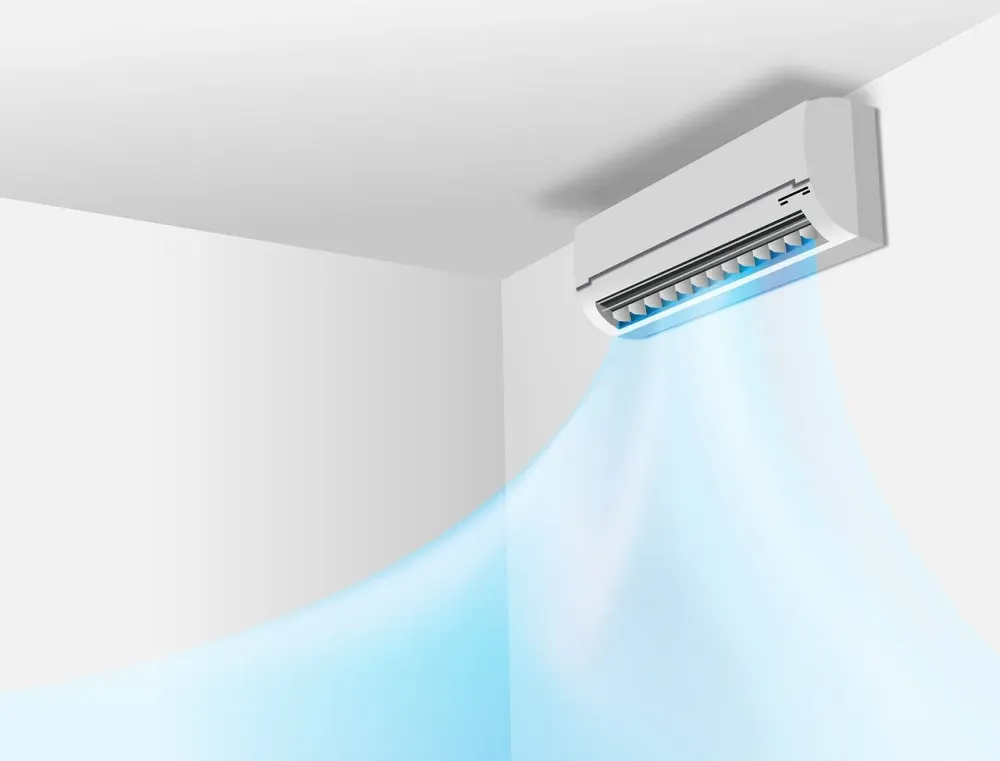
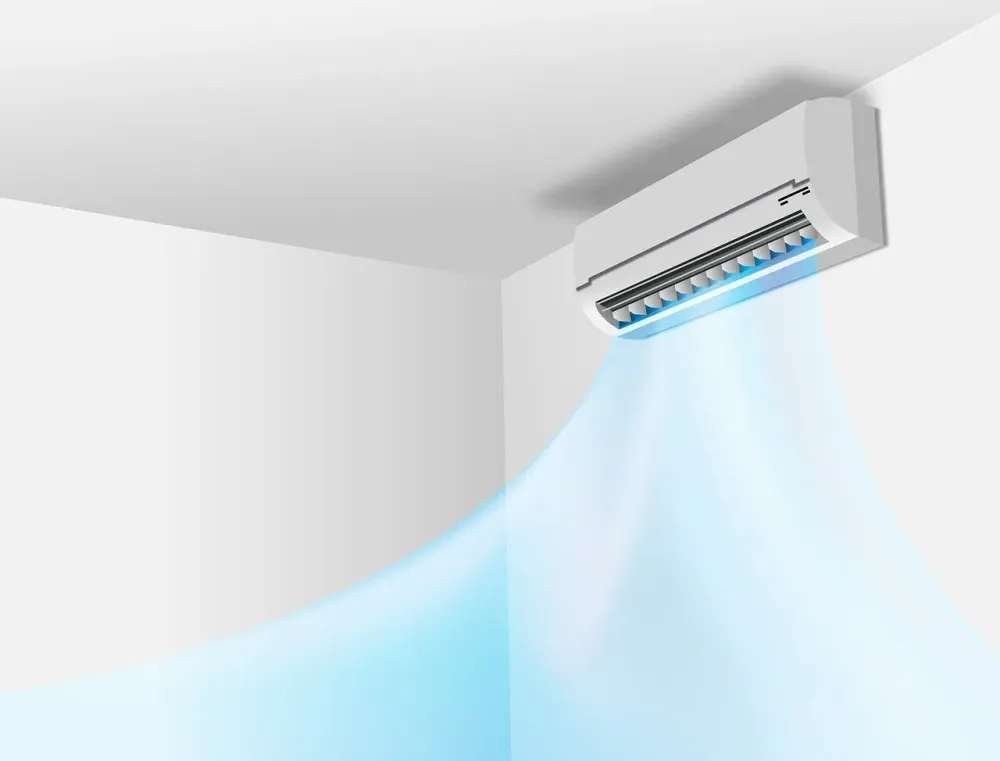
Many owners of old Taiwanese apartments who install a new inverter air conditioner find that the dedicated AC outlet on the wall has only two holes (one live, one neutral). Others have a three-hole outlet, but often feel a prickly tingle when they touch the AC's copper pipes or the outdoor unit casing (induced voltage). Opening the outlet faceplate reveals only two thick wires inside, and the green equipment ground wire that is supposed to protect life is left dangling or was never run at all! An AC with no ground not only carries a lethal leakage and electric shock hazard, it is also much more likely to have its precision inverter board punched through and ruined by lightning surges and high-frequency noise.
Warning: before opening the junction box of a dedicated 220V or 110V AC outlet, you must first go to the home's main distribution panel and switch the double-pole no-fuse breaker (NFB, 無熔絲開關) labeled for the AC (2P NFB) fully to OFF. Then use the AC voltage range of a multimeter (ACV 600V) to measure across both terminals and confirm the voltage is 0V! Both conductors of a 220V circuit are 110V live lines to ground, and working on live wiring easily causes arc flash and severe electric shock leading to collapse.
Why AC units depend so heavily on a ground wire: filtering induced voltage and leakage protection
A modern inverter air conditioner uses high-frequency pulse-width modulation (PWM) to control the inverter compressor speed, and the power input of its board has an EMI (electromagnetic interference) filter (Noise Filter). The filter contains two Y capacitors connected between the live line and the ground wire.
If the outlet has a proper third-wire ground, the small noise current flows naturally into the earth. Without a ground wire, however, the voltage-divider effect of the Y capacitors can give the AC's metal casing and copper pipes an "induced AC voltage" to ground as high as 55V-110V! The current is small, but a person standing barefoot on wet tile who touches the metal will feel a strong shock. And if the compressor's insulation degrades and a real short circuit occurs, the casing instantly carries a lethal 220V, and the person touching it will be unable to let go and will be electrocuted.
The most dangerous corner-cutting: checking for a "fake ground"
- Neutral and ground bonded together at the outlet (ground-neutral short): to get past inspection, an unscrupulous electrician snips a short piece of green wire inside the outlet box and jumpers the neutral (N) hole straight to the ground (GND) hole. Under the electrical regulations this is an extremely dangerous, serious violation! If the building's incoming neutral comes loose or loses contact, the neutral potential, which should be 0V, instantly rises to 110V, and that voltage goes straight onto the AC's metal casing, so touching the casing gives an immediate shock!
- Ground wire casually screwed to the back plate of a metal box (floating ground): the ground wire is screwed into a screw hole of the metal junction box inside the wall. Unless that box is itself reliably connected to the ground copper bar of the distribution panel through continuous galvanized conduit, this is an ineffective "floating ground" with no conductive path at all.
3 compliant ways to fix a missing ground or run a new ground wire
- Pull a separate green ground wire through the concealed conduit from the main panel (the ideal standard method):
- Using a fiberglass fish tape, thread a 2.0mm or 3.5mm² pure-copper green insulated conductor along the existing dedicated AC conduit.
- In the panel, screw the green wire onto the ground bus copper bar that is connected to the building's main ground wire; at the outlet, push the green wire firmly into the dedicated ground terminal.
- Replace the AC circuit breaker with one that has earth-leakage protection (RCBO / ELCB, the lifesaving method that needs no new wiring):
- If the conduit was completely blocked by cement debris during renovation and no third wire can physically be pulled, the alternative the regulations allow is to replace the ordinary no-fuse breaker (NFB, 無熔絲開關) of the AC circuit in the panel with a "high-sensitivity, high-speed earth-leakage circuit breaker (ELCB, 漏電斷路器) (operating current 30mA, operating time within 0.1 second)".
- It cannot remove the slight induced voltage from the Y capacitors, but whenever a person receives a shock or the AC's leakage current exceeds 30mA, the breaker trips within 0.1 second and cuts the power, protecting life.
- Drive a separate ground rod for the outdoor unit casing (suitable for detached houses):
- For a freestanding multi-storey house (透天厝), run a 5.5mm² green ground wire from the metal grounding screw on the outdoor unit base vertically down to bare soil, and drive in a stainless copper-clad steel ground rod at least 1.5 meters long. The ground resistance must be below 100 ohms (Class 3 grounding, 三種接地).
Cost and safety comparison of common grounding retrofit methods
| Grounding fix |
Protection against electric shock |
Eliminates the tingling induced voltage on the casing |
Surge protection for the inverter board |
Budget per location (TWD) |
| Pull a dedicated green ground wire from the panel |
★★★★★ (highest standard) |
★★★★★ (100% eliminated) |
★★★★★ (surges drain smoothly to earth) |
NT$1,800 - NT$3,500 |
| Replace with an earth-leakage breaker (2P 30A) |
★★★★★ (trips instantly on leakage) |
★☆☆☆☆ (induced voltage remains) |
★★☆☆☆ (no path to discharge surges) |
NT$1,200 - NT$2,200 |
| Jumper neutral to ground at the outlet (fake ground) |
☆☆☆☆☆ (illegal and extremely dangerous) |
☆☆☆☆☆ (a neutral fault is certain to be fatal) |
☆☆☆☆☆ (very likely to short-circuit and start a fire) |
Strictly prohibited! |
Official electrical safety regulations and inspection standards
Equipment grounding, ground resistance (for a single-phase three-wire supply it must reach 100 ohms or less) and conductor sizes for low-voltage electrical equipment must strictly follow the "Grounding Methods and Standards" in the Ministry of Economic Affairs' Regulations for Installation of Customer Electrical Equipment (用戶用電設備裝置規則), Articles 24 to 29. For the electrical insulation and safety inspection of air conditioners, see the Bureau of Standards, Metrology and Inspection (BSMI) standard CNS 2060, Window-type and Split-type Air Conditioners (窗型與分離式空氣調節機).
More on circuit grounding and distribution panel safety: testing three-hole outlets for reversed polarity with a phase tester, and replacing the crimp terminals of a blackened, melted dedicated 220V AC outlet.
FAQ
Q1: Can I plug an AC in through a three-to-two-hole adapter (豆腐頭) with its ground pin snapped off?
Absolutely prohibited! An AC draws a very large running current (the starting current can reach more than ten amperes). The cheap adapters sold for tens of NT dollars have very thin copper contacts and poor clamping force. Breaking off the ground pin not only removes all shock protection; the excessive contact resistance will also heat up to hundreds of degrees within a few months, melting and blackening the plastic plug and outlet together and causing a fire!
Q2: There is no ground wire in the outlet box. Can I just tie any wire to a nearby aluminum window or iron railing as the ground?
Absolutely not! Aluminum doors and windows and iron railings are fixed to dry concrete walls and have no conductive path deep into the earth (the ground resistance can be as high as tens of thousands of ohms). If the AC leaks, the whole aluminum window and even the connected metal railings become live at a lethal 220V, and on a rainy day a family member reaching out to close the window will receive a fatal shock!
Q3: I bought a digital phase tester and plugged it in, and it shows "OPEN GROUND". What does that mean?
"OPEN GROUND" means the round ground hole of the outlet is "actually a dead wire inside (not connected, or broken)", a dummy three-hole outlet. An electrician must then inspect the distribution panel and run a new ground wire.
Q4: The AC's metal casing gives a prickly tingle. Will a test pen light up when I touch it?
Yes! A high-impedance neon test pen gives off a faint red glow whenever it senses an induced voltage above 50V. This happens because the Y capacitors cannot drain high-frequency static and induced voltage. Once the third-wire ground is properly connected, the casing-to-ground voltage drops to 0V instantly, the test pen goes out, and the casing feels completely smooth with no tingle.